Xplorich
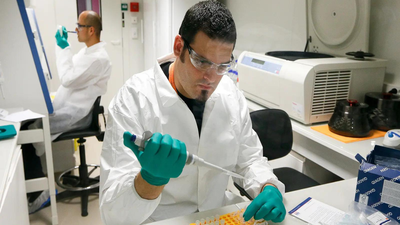
Marking a breakthrough in biological engineering, researchers claim to have created the world’s first synthetic cells that can feed, grow and replicate like a natural cell, taking a big step towards the holy grail of making a living organism out of non-living components.Developed by University of Minnesota scientists under a project called SpudCell, the work could in time lead to made-to-order living machines.“We’ve replicated in chemistry what only used to be possible in biology: the complete set of behaviours of a cell. It proves that fundamental functions of life, like growth and replication, don’t need a mysterious magical spark,” said Kate Adamala, who led the effort, in a note released by the varsity.The SpudCell isn’t quite ‘alive’. It can’t survive without deliveries of food and ribosomes, the molecular machines needed to make proteins. It also has no defences or a good waste removal system.
SpudCell: Genetic change helped cells grow faster
But experts said it’s the most compelling demonstration yet that it is possible to generate life from non-life. “This work is just the beginning. We are showing it’s possible to engineer the basic functions of the cell. To fully realise the promise of this technology — to make it robust and practical — we need combined international effort,” Adamala said.SpudCell is a pared down version of a living cell. While natural cells divide using internal scaffolding called a cytoskeleton, the synthetic cell sidesteps the need for a cytoskeleton with proteins that crowd together on the membrane surface until the mechanical stress makes the membrane split. Researchers introduced a genetic change that increased production of fusion protein, resulting in cells that grew faster and produced more offspring. After five generations, the faster-growing variant had out-competed the original, the university said.While a human genome is roughly 3 million kilobase pairs (kbp) in size, SpudCell’s genome is relatively tiny at 90 kbp. Rather than a single chromosome, the genome is split across seven separate DNA plasmids, allowing the team to “program” various functions of the cell independently.