Xplorich
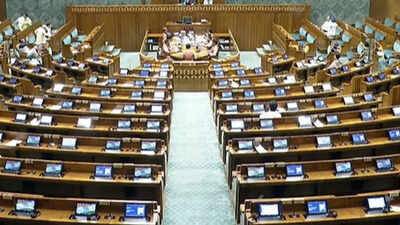
NEW DELHI: The Nari Shakti Vandan Adhiniyam – historic bills seeking 33 per cent women’s quota in legislatures – is set to be moved by the Centre in the special session of Parliament.The discussion will revolve around the proposed constitutional amendments linked to the implementation of the Nari Shakti Vandan Adhiniyam.Ahead of the session, Prime Minister Narendra Modi said the nation is set to take a historic step towards women’s empowerment.In a post on X, PM Modi said, “Starting today, in the special session of Parliament, our country is all set to take a historic step towards women’s empowerment. The respect for our mothers and sisters is the respect for the nation, and with this very spirit, we are moving forward resolutely in this direction.”What’s in the Women’s Reservation BillFormally known as the Nari Shakti Vandan Adhiniyam, the Women’s Reservation Bill is a constitutional amendment that seeks reservation of 33 per cent of seats in the Lok Sabha and state legislative assemblies for women.If the proposed changes are carried through, the shape of India’s Parliament will be fundamentally altered, both in size and representation.
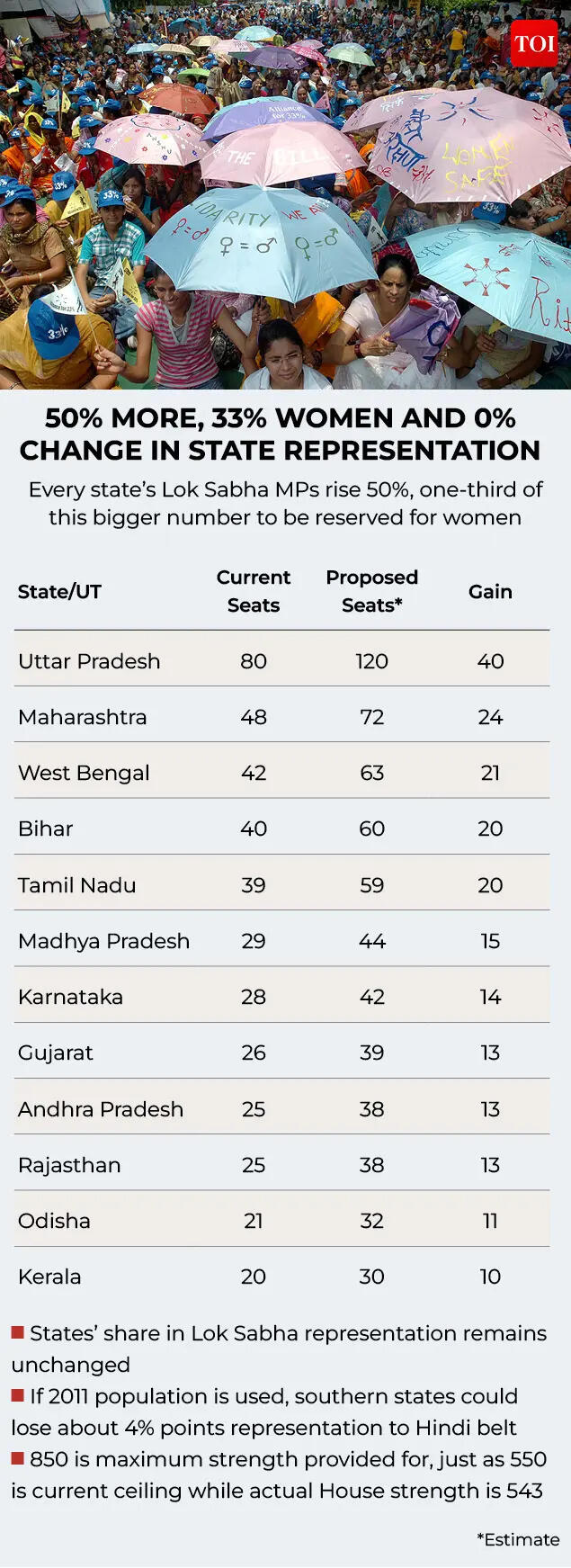
The Lok Sabha is expected to expand significantly from its current strength of 543 seats to 850. Within this expanded House, one-third of the seats—around 283—would be reserved for women, marking the first time such a quota is implemented at the national level.The Bill was passed in 2023 in the new Parliament building. However, the quota would come into effect only after the completion of the delimitation exercise based on the 2027 Census, meaning the reservation would not be enforceable before 2034 under the original law.For this, the Centre has also moved a Delimitation Bill.What is delimitation?The delimitation exercise is being closely watched as the government is keen to reserve 33% of seats for women in the Lok Sabha and state assemblies from the 2029 general elections, without changing the proportion of seats allotted to each state.It is an exercise to redraw constituencies for the Lok Sabha and state assemblies, based on population. Article 82 of the Constitution mandates that this exercise be undertaken after every census.While three delimitation exercises were undertaken in each decade starting 1952, in 1976 the 42nd Constitutional Amendment suspended the revision until after the 2001 Census and froze the number of Lok Sabha seats at 543.The Constitution empowers Parliament to decide on delimitation, and the government is moving a Bill to set up a Delimitation Commission. The Commission is proposed to be headed by a former Supreme Court judge, with the Chief Election Commissioner or his nominee as a member.Why is the Opposition resisting?The opposition has said that although it supports the women’s quota Bill, the government’s move to link it with delimitation ahead of the 2029 Lok Sabha elections has compelled it to oppose the Bills.Congress MP Jairam Ramesh said that while the government is “packaging and marketing” the three Bills, the fundamentals relate to delimitation.“Three Bills are being taken up in the Lok Sabha. The packaging and marketing is women’s reservation, but the fundamentals have to do with delimitation,” Ramesh said.“Many concerns have been raised across the country regarding the delimitation proposals that privilege a few populous states where the BJP is strong now. The relative strength of a number of states in the Lok Sabha will actually decline. The way delimitation has been done in Assam and Jammu and Kashmir shows how the Modi-Shah duo work. The true intent of these Bills is mischievous, their content devious, and their damage enormous. They have to be rejected completely in their present shape and form,” he added.He said the opposition’s demand is simple: reserve one-third of the current 543 seats in the Lok Sabha for women, along with quotas for women from SC, ST, and OBC communities. This was its position in 2023 and remains unchanged. It argues that this represents genuine power-sharing, is more democratic, and aligns with constitutional values and principles.Additionally, the introduction of the new Bills has also triggered a north–south divide.Tamil Nadu chief minister MK Stalin on raised a black flag and burned a copy of the Delimitation Bill to protest the proposed exercise.The protest follows a stern warning issued to the BJP-led Centre over convening a special session of Parliament to pass the delimitation Bill, through which representation of southern states is expected to reduce significantly.What is the government’s stand?Meanwhile, the government has said the Women’s Reservation Bill is balanced and fulfils the aspirations of every state, community, and region.Union parliamentary affairs minister Kiren Rijiju slammed the opposition for spreading rumours over delimitation.“But after giving 33% reservation, history will be made. India will set an example for the entire world on how big a step we are taking for women, and there should be no opposition to this. Secondly, women’s reservation should not be undermined by raising issues like delimitation or anything else, because confusion is being spread about delimitation. No one is going to be harmed; it will be clarified in Parliament,” Rijiju said ahead of the session.“I am not giving detailed figures right now because it will lead to discussions. During the discussion today, everything will come out clearly from the government’s side. But some parties have tried to spread the wrong message about delimitation in South India. They should not do that,” he added.How the numbers stack upThe constitutional amendment Bills require a special majority of two-thirds of those present and voting to be passed. Any walkout or abstention by the Opposition could lower the effective majority threshold.With an effective strength of 537 in the Lok Sabha, the two-thirds mark comes to 360. The ruling NDA, with 293 members, falls short by 67 seats.In the Rajya Sabha, the magic number is 163, while the NDA’s strength of 142-plus members leaves it 21 seats short of the majority mark.Adding to the government’s challenges, parties such as Naveen Patnaik’s Biju Janata Dal and K. Chandrasekhar Rao’s Bharat Rashtra Samithi, which had extended issue-based support earlier, have now hardened their stance on delimitation.However, the government has maintained that it has the numbers. “I am not going into the politics of which party is saying what. No party is opposing the women’s reservation in Parliament and assemblies. In principle and in spirit, everybody is together,” said Union Minister Kiren Rijiju.