Xplorich
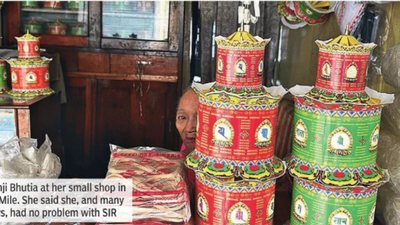
In Bengal, the special intensive revision (SIR) of electoral rolls has triggered sharp political controversy, with allegations that large numbers of people risk being struck off voter lists. But in Kalimpong’s Tibetan settlement, many residents recall the experience of voter verification very differently — as a process that recognised settled communities rather than excluding them.In this hill town, where Tibetans have lived for decades across generations, residents and settlement officials say the scrutiny has so far thrown up only a small number of discrepancies. Many argue that when such exercises are carried out with care and with reference to older records, they can confirm legitimate voters instead of disenfranchising them.At a small shop in 10th Mile, 72-year-old Khamji Bhutia dismissed fears around the exercise. “We don’t have any problem with SIR. We were born here,” she said.That sense of confidence comes from a longer local history. Not all Tibetans in Kalimpong arrived after China’s occupation of Tibet in 1959. Some families had settled in the town earlier, when Kalimpong was an important trading hub. Traders travelled through Nathu La and Jelep La carrying wool, salt, borax and livestock; some stayed back, opened businesses and built homes.“I came years before China occupied Tibet,” said 82-year-old Jampel Kaldhen, who came to Kalimpong in 1954 when he was 12. He said language was not a barrier for him. “My third language was Sanskrit. I could easily communicate in Hindi.”Others came later, fleeing repression and rebuilding their lives from scratch in India. Many found work as labourers before moving into small trades and businesses.“We all worked as labourers. We used to go for road construction in Lava, all men and women… we all worked. We made that road,” said 78-year-old Namdol Bhuta, referring to the route to the tourist spot in Kalimpong district.For many here, that history shapes the way they see electoral verification. Inclusion in the voter roll is not just a matter of documentation; it is recognition of residence, labour and belonging built over decades.Residents and local officials say most Tibetans in Kalimpong already have documentary continuity. According to those familiar with the settlement, the Tibetan population in the area is estimated at around 1,928. The present questions, they say, largely reflect a generational divide: many older Tibetans still hold refugee certificates, while younger members of the community, especially those born in India, are more likely to possess Aadhaar cards and voter identity cards.“Those who continue to hold refugee certificates are often the ones who remain deeply rooted in their Tibetan identity and prefer not to transition away from it,” said Tenzing Bhutia, a resident of Kalimpong.Tashi Bhutia, a retired teacher from St Augustine School, said his grandfather was born in Darjeeling. His father was later sent to Tibet to become a monk and returned years later. He stressed that the community cannot be seen through a single refugee narrative. “Not all Tibetans here fled Tibet after 1959. Some were born here. Some were living here for generations,” he said.Tseten, the local Tibetan settlement officer, said most Tibetans in Kalimpong had obtained documents before 2000, and had participated in earlier elections, including in 2002. That, he said, has helped during the present revision because many names can be checked against older electoral rolls.“We don’t have many cases in the SIR, just a handful. Most have their documents,” Tseten said. “I don’t think there are deleted cases.”Kalimpong’s experience does not settle the larger political argument around SIR in Bengal. But it does point to one distinction: verification exercises need not automatically become instruments of exclusion. Where officials rely on older records, documentary continuity and local history, settled communities are less likely to be treated as suspect.