Xplorich

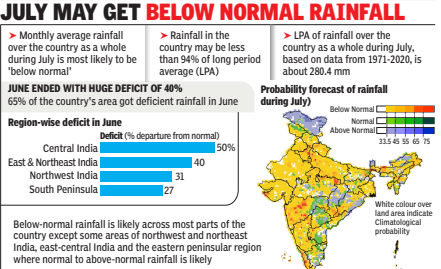
NEW DELHI: The current rainfall deficit of 40% across the country may reduce due to good rains in the next 7-10 days as monsoon advances further into the country, but overall rainfall is likely to be ‘below normal’ in most parts of the country in July, IMD said in its latest forecast Tuesday. Monsoon is expected to cover Delhi, Haryana, Punjab and some places in Rajasthan during the next 2-3 days. July is also likely to be warmer than usual as the met department has predicted “above normal” temperatures at several places. IMD said formation of a low-pressure system over Bay of Bengal is likely to aid rainfall in the first 10 days of July, with showers covering most parts of central India, from Odisha and West Bengal to Gujarat and Maharashtra.
.
Conditions are favourable for further advance of southwest monsoon into the remaining parts of Uttarakhand, Himachaland Ladakh, some more parts of Gujarat, Madhya Pradesh, UP, all of Daman & Diu, J&K, most parts of Haryana-Chandigarh-Delhi and Punjab, and some parts of Rajasthan during the next 2-3 days,” IMD director general Mrutyunjay Mohapatra said. He said the likely wet spell during the next 7-10 days may help sowing operations, particularly in the ‘monsoon core zone’ — the country’s rain-fed area, mainly in central India, where farming depends largely on the seasonal rainfall. July is normally the wettest month of the season and the most crucial period for sowing of kharif crops. Noting that “rainfall over all India (99.5 mm) was fifth-lowest June rainfall since 1901”, Mohapatra said, “There was a negative impact on rainfall activity over the Indian region due to the development of El Niño, while the Indian Ocean Dipole (IOD), which is in neutral phase, could not help to compensate the negative impact of El Niño.” Not a single low-pressure system formed during June, he added.
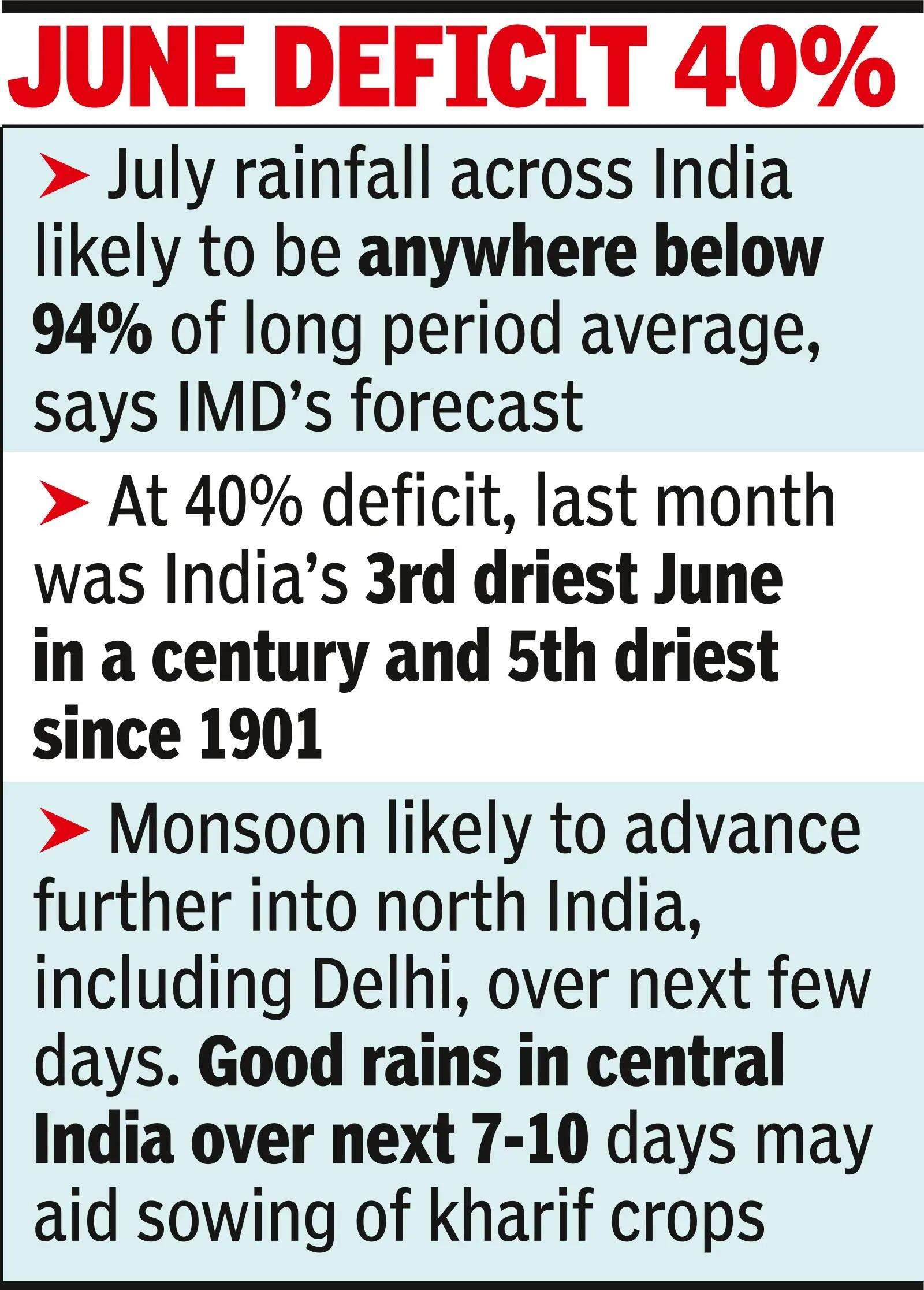
The lowest ever rainfall in June was recorded in 2009 (87.6mm), an El Niño year that saw a major drought, followed by 1905 (91.9mm), 2014 (92.8mm), 1926 (96.7mm) and 2026 (99.5mm). This year, India received the lowest June rainfall after 2014, which was another drought year. IOD, which in the positive phase is known to soften the adverse impact of El Niño, continues to be in neutral phase, as per IMD’s model. However, some global models hint at the possibility of it turning positive by the end of Aug or early Sept. If that happens, the second half of the monsoon season may get slightly better rainfall, but it may not offset the June-July deficit, IMD said. El Niño Southern Oscillation and Indian Ocean Dipole are two key factors that govern variation in monsoon rainfall. “Currently, neutral IOD conditions are being observed over the Indian Ocean. IMD’s model forecast indicates that neutral IOD conditions are likely to persist during the southwest (summer) monsoon season,” said Mohapatra.